
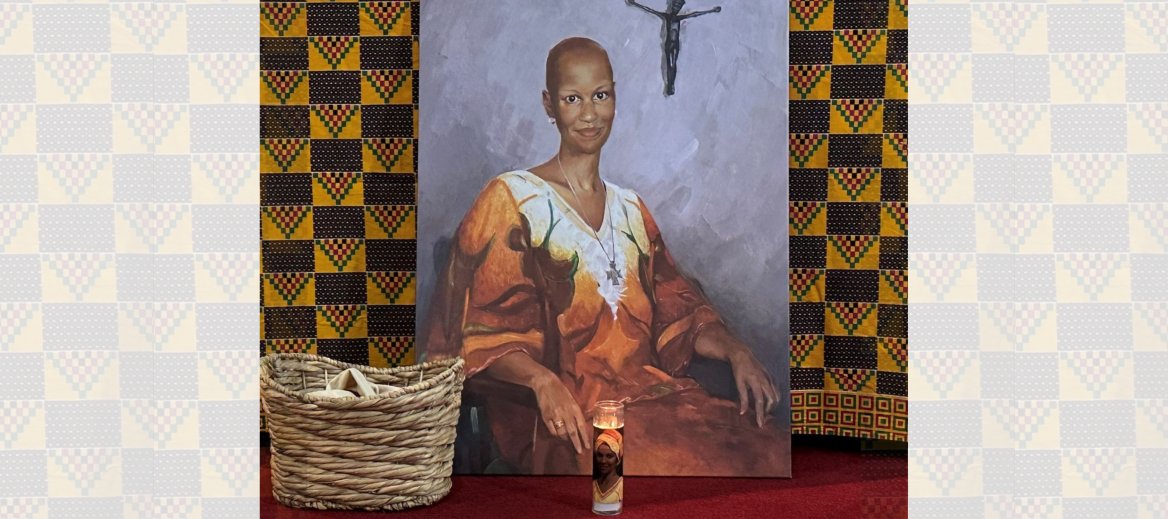
Anticipation and inspiration were palpable on a bus bound from Jackson, Mississippi, to Mobile and Montgomery, Alabama, in November of 2025, during both Black Catholic History Month and the Jubilee Year of Hope. It was filled with pilgrims — 27 charter members of the newly-launched Sr. Thea Bowman Guild, led by Mary Woodward, chancellor of the Catholic Diocese of Jackson and diocesan liaison for Sister Thea’s canonization cause — embarking “On the Road to Sainthood: Embracing the Witness of Black Catholics.” The bus was fueled by the Franciscan Sister of Perpetual Adoration’s legacy of embracing diversity, serving others and inspiring discipleship — her luminous flame that feeds what it means to be Black and Catholic.
Mile after mile, her essence grew stronger.
The vibrancy of Sister Thea filled the Archdiocese of Mobile’s Prince of Peace Parish to the brim, where pilgrims experienced the brilliant pomp and circumstance of a Black Catholic History Month celebration. The Knights of Peter Claver, regally plumed in gold, orange and blue, led the procession. Portraits of Sister Thea and the Saintly Six were brought forth. A gospel choir performed, and Reverend Tony Ricard echoed Sister Thea's voice in her proclamation to the world, “We are not asking somebody to welcome us to their church, we’re saying that this, too, is our church.” After the program, guests were lavished with fantastic Southern food and jazz music that lit up the night.
Sister Thea’s joyful presence filled every moment of the experience.


Images include the interior of Prince of Peace Catholic Church during the celebration, "Servant of God Sister Thea Bowman: On the Road to Sainthood, Embracing the Witness of Black Culture," in Mobile, Alabama, on Nov. 15; a gospel choir performs during the program; and Reverend Tony Ricar speaks of Sister Thea and her cause for canonization (photo by Rob Herbst/Archdiocese of Mobile, Alabama).
Sister Thea's constant call to confront racial injustice was tactile at the Legacy Sites in Montgomery. Built upon the grounds of a former cotton warehouse where enslaved African Americans were forced into brutal and deadly labor is the Legacy Museum, where the pilgrims passed through many exhibits that included floor-to-ceiling shelves holding hundreds of mason jars filled with soil respectfully gathered from lynching sites. There, the pilgrims encountered holographic slaves and their children, gravely speaking of their personal pain through the bars of tiny incarceration cells. At the National Memorial for Peace and Justice, they passed underneath the heavy shadow of a sky-high monument engraved with the names of more than 4,400 Black people killed between 1877 and 1950. In the Freedom Monument Sculpture Park, the pilgrims witnessed a cabin, transplanted from a South Carolina plantation, in which slaves fought for some semblance of life for themselves and their families.
Sister Thea’s powerful demand for racial justice and humanity propelled them.


Images from the Legacy Sites in Montgomery, Alabama (center image by the Legacy Sites)
The bus then delivered the pilgrims to Montgomery’s City of St. Jude Parish, founded by Father Harold Purcellas, a Catholic mission established in 1934 to provide education, health care and social services to the Black community. A sanctuary of civil rights as well as the final stop for those marching from Selma to the Capital of Montgomery in 1965, St. Jude is known as a “city within a city,” a culture committed to human rights and social justice for the African-American community there and throughout the broader Deep South … “exemplified for the world to see.”
The final event of the pilgrimage was a grand gathering, befitting of a Sister Thea, at St. Jude Church. The event was bursting with brilliant music and stories of her influence on the Black Catholic community as an educator of students in schools from elementary through seminary, a consultant for intercultural awareness and a renowned singer, preacher, prayer leader and storyteller who famously demanded witness of the United States Conference of Catholic Bishops in 1989. “I bring myself; my Black self, all that I am, all that I hope to become.”


Images include a painting inside St. Jude Church, a group of presenters who spoke during the celebration of Sister Thea on Nov. 16 and the Sr. Thea Bowman Guild gathered outside on that day.
Within the growing distance from the Road to Sainthood to today, pilgrims continually reflect on the exquisite experience. “Meeting those who knew Sister Thea and listening to their stories was beautiful and transcended my anticipation for the pilgrimage,” shared a young woman who traveled from Minnesota to board the bus in Jackson and celebrate Sister Thea. “My capacity to hold empathy and kindness to the world around me has truly expanded since the journey.” Says Mary, “We encountered the rich and deep faith of our church in a unique and profound way. It was an honor to be a part of this journey of hope with such an inspiring group of people from our diocese. We are already thinking of future ventures.”
Diocesan phase closing
And Sister Thea’s posthumous path to sainthood, paved by her profound influence on Black Catholicism, is finally making its way to Rome in Italy. Diocese of Jackson Bishop Joseph R. Kopacz has announced the Closing Ceremony for the Diocesan Phase of Servant of God Sr. Thea Bowman, FSPA. The event will be held on Monday, Feb. 9, at 12 p.m. in the Cathedral of St. Peter the Apostle. Bishop Kopacz, along with other bishops and clergy from the Province of Mobile, will celebrate a Mass of Thanksgiving at noon.

Immediately following the Mass, the Closing Session will begin in the Cathedral with the Postulator from Rome and the Cause Tribunal sealing the boxes containing the acts (documents and findings) of the diocesan phase exploring the life and virtues of Sister Thea. These boxes will be shipped to the Apostolic Nunciature in Washington for transfer to the Dicastery for the Causes of Saints at the Vatican. All are invited to come and celebrate this momentous occasion.
Stay tuned for updates in this process as they unfold, and visit jacksondiocese.org to learn about the historical and theological cause for her canonization. You can also share her light by joining the Sister Thea Bowman Guild. And there is much more to explore about Sister Thea, including the documentary, “Going Home Like a Shooting Star,” at fspa.org.