
By Kristin Peters, Franciscan Sister of Perpetual Adoration
Since attending the Women & Water Coming Together Symposium in August, Franciscan Sister of Perpetual Adoration Kristin Peters has felt a deep, rising call to “live with a spirit of love and deep respect, even reverence for that which we depend upon for life — this land and its waters.”
She is joining her voice with the women of the clean water summit, led by Maryellen Baker, Ojibwe Grandmother and President of Abiinooji Aki Inc., an organization missioned to provide cultural healing, spiritual growth, community programs and the empowerment of women to strengthen “the overall health of the Lac Courte Oreilles community and beyond.” This land and its waters.
Maryellen is calling upon 5,000 women “of every nation, race and color to unite in strength, wisdom and compassion … to stand up for clean water laws and future life to come,” at the 2026 Women & Water Indigenous International Clean Water Summit, Sept. 24 to 26, upon the land of the Lac Courte Oreilles reservation near Hayward, Wisconsin.
Sister Kristin, along with Sisters of Charity of the Blessed Virgin Colleen M. McGinnity, Mary Kate Hendel, Ann DeNicolo and Marguerite Murphy, with Sister of Providence Joni Luna and Sister of the Presentation Jessie Beck, is inviting 200 Catholic sisters to join them.
“When women thrive, communities flourish,” says Maryellen. And “when women are healed, the world is healed.”
What follows is a reflection written by Sister Kristin in which she shares her symposium experience of "moments in which the human and divine met" and four simple actions you can take to support the Women & Water Coming Together movement.
Maryellen Baker of the Lac Courte Oreilles Ojibwe tribal nation near Hayward, Wisconsin, brought together nearly 100 people last August to learn from Indigenous elders and leaders about protecting the water at the symposium, Women & Water Coming Together.
Throughout four days, there were many moments where the human and divine met. The human experience of grief, loss and trauma was addressed through several ceremonies of healing. One sharing related the pain experienced with respect to the Catholic Church. Humanness showed up in me as I squirmed in my seat, wondering if this moment would lead to shame and rejection. Instead, the sisters were specifically thanked for listening, for not walking out. We were invited up to receive tobacco. (Sacred tobacco is used in many tribes for prayer, healing and communication with ancestors or the Creator.) Grief and gratitude flowed through me and tears streamed down my face. Maryellen invited the traditional people in the lodge to stand with her and behind her. They formed a line of about 20 people, back to back. We sisters went from person to person, held hands, looked into each other’s eyes, heard brief stories and, at times, embraced. We met each other again or perhaps for the first time.
This was a moment when we came together. Invited in, rather than blamed and turned away. As I write about this experience, gratitude and love bubble up. With a spirit of humility and reverence, I recall that we are in relationship in a new way. I know joy and possibility born out of a generous spirit. I believe we are invited in to do the work with a new spirit being born now and needed for these times.

A Women & Water Coming Together Symposium banner, bearing an eagle, was hung at the west door of the teaching lodge. It guided us throughout the four-day experience. The eagle, the divine, also watched us leave through the western door at the end of the lodge. The eagle is a sacred messenger and carrier of truth. At the completion of the sacred ceremonies and teachings that called us together to protect the waters, Maryellen gifted FSPA this banner. I believe we religious women are being invited in to do the work of repair together. Restorative justice is about moving with an attitude of respect and valuing relationships. We are human and divine. We fall and get up, learning to walk in a more respectful way toward all creation and all people. We are presently being invited into that relationship with Indigenous people and ways.
The Indigenous lens is that water is life, and we are all of these waters. How can I learn to move in a way that acknowledges and respects the Indigenous view, even learning to listen to the voice of water?
I reflect on my life today. The earth is crying out with the increasing season. The Church helps us lean in, looking with the lens of Pope Francis’ encyclical, Laudato Si’. Simultaneously, the call of St. Francis invites me to treat with reverence and kindness all creation and each other; even to pardon each other. We are listening to the grief and allowing the truth to move through us. The only question is, “How will we respond today, as a result of what we hear and feel in this moment?” As you continue to read, ask yourself the questions “Who am I? Who are we? What kind of contribution do I want to make to the world and to the community of which I am made?”
The symposium also hosted respected leaders such as Chickadee Richards from Manitoba, Canada, who spoke about the efforts to mine silica from her homeland. She shared about the ongoing fight they are engaged in to protect the water. Mining and tribal sovereignty are interrelated, because many of the elements needed for green technology are found on tribal lands. Chickadee, with resolve and strength, talked of her removal from the land because of the fires: They are burning right over the area where the corporation wants to mine. Indigenous people lead the fight to protect the earth, air and water. We can follow their lead.
She also spoke of youth with “nothing to lose” at the front of the fight. With water polluted, the fabric of life — seven generations following us — will be similarly at risk.
Michael Waasegiizhig-Price shared an Anishinaabe perspective on the beaver, who models the four Rs: Reciprocity, Respect, Responsibility and Relationship. The animal, thought to be a nuisance by early settlers, was over-trapped. We sought to control the waters ourselves by building dams. We learned that today, especially in the west where they are struggling with water access, the beaver can help manage the flow of water. The teaching, articulated by one of the elders in the crowd, was to learn from the beaver and the impact of our relationship with the land so that we can repair or live in right-relationship. The meaning of decolonization is learning from our relationship with the beaver — past, present and future.
The physical structure of the lodge was extended to hold the over 70 women who gathered. Among the participants — both Native and non-Native — were representatives from the Franciscan Sisters of Little Falls, Minnesota, the Franciscan Sisters of Perpetual Adoration (my community) from La Crosse, Wisconsin, the Sisters of the Presentation of the Blessed Virgin Mary and the Sisters of Charity of the Blessed Virgin Mary from Dubuque, Iowa, and the Sisters of Providence of Saint-Mary-of-the-Woods in Indiana. Having supported each other in different ways over several years, participants in the Women & Water gathering have nurtured relationships with the practice of respect, reciprocity and responsibility.
For example, a month ago, several women religious at the symposium, along with Indigenous elders and members of Land Justice Futures, went to Arizona to stand with the Apache to protect their land and water from Copper Mining at Oak Flat. Additionally, and again with the support of Land Justice Futures, many of us have studied the short- and long-term impacts of the Doctrine of Discovery throughout the world with trusted sources that include The Gilder Lehrman Institute of American History and The Coalition to Dismantle the Doctrine of Discovery. We read authors like Sarah Augustine, whose book is titled “The Land is Not Empty.” We participated in JustFaith Ministries to learn about Indigenous justice and the invitation of individuals, churches and communities to divest from stocks supporting industrial mining companies. Using resources that include “Healing Haunted Histories: A Settler Discipleship of Decolonization” by Elaine Ens and Ched Myers, we examined or sought out the "push-pull" factors that led our own families or communities to settle in the United States and examined the impact of those decisions on local Indigenous people.
"We need to respect this place. We are invited to be people of this land and its waters. We are whole only when we live with a spirit of love and deep respect, even reverence for that which we depend upon for life."
We remember the words of Diné teacher, Pat McCabe: “Always hold life at the center” in anything that you do. Sisters have considered these words as we have made decisions and considered how to respond to “properties” (a utilitarian, capitalistic view of land) of which our time of stewarding is ending. How are we with our neighbors who have historically been disinherited from land, religion, language and culture by oppression? How are we going to respond? This is the invitation of the story of Good Samaritan.
We know land provides nourishment, life and breath and that those who are poor are so often denied access to land and clean air and water. We have the opportunity to provide easier access as we consider how to use our advantages and act in an equanimous, good, kind and just way. We can center land rights, movements of "rematriation," returning land to our Mother Earth and disadvantaged neighbors in our discernment. Like Elijah in the cave, I hear God's gentle call in this invitation. And I believe we in the Catholic Church are on the precipice of a great movement of reawakening.
In May of 2025, the United States Supreme Court refused to take the Apache Stronghold case, which addresses “whether the government ‘substantially burdens’ religious exercise under the Religious Freedom Restoration Act, or must satisfy heightened scrutiny under the free exercise clause of the First Amendment, when it singles out a sacred site for complete physical destruction, ending specific religious rituals forever.” Justice Neil Gorsuch, joined by Justice Clarence Thomas, dissented from the Court’s denial, writing that its “decision to shuffle this case off our docket without a full airing is a grievous mistake — one with consequences that threaten to reverberate for generations.”
On June 23, 2025, Apache Stronghold filed a motion for rehearing at the Supreme Court, asking our justices to reconsider. Four months later, the court declined to rehear the case. Because the U.S. Court of Appeals for the Ninth Circuit addressed only some of the issues in the case, the dispute is now continuing in the federal district court of Arizona. Representative Adelita Grijalva introduced the bill; each of us can call our state’s representatives and senators to ask them to support this bill and protect religious rights.
Wendsler Nosie, Sr., of Apache Stronghold writes that “Oak Flat is the cornerstone of our faith — the place where generations of Apache have gathered, prayed, and connected with the Creator since time immemorial. It is not a resource to be exploited for profit. It is a holy place where our children and grandchildren must be able to walk, just as our ancestors did. Apache Stronghold gives its full support to Rep. Grijalva’s Save Oak Flat Act.”
The ceremonial space of the lodge was sacred, similar to liturgy within our Catholic faith. The elements of fire and water are central; the invitation to hold life at the center resonates with what, as Catholics, we say at Mass and often in our prayers. There are differences in our language. As Catholics, we believe we become complete as we manifest God’s call, Christ’s consciousness, and live our mission as a member of the universal church. The project of capitalism, colonization, individualism and competition leave their mark on the Church. It is easy to lose focus on the four R’s, because money is a central value. As a corporation, it appears necessary to maintain the status quo. The papal bulls are the basis of U.S. property law (Indian Country Today and 1493 Papal Bull). Is there really any way to remove the veil of colonization from our midst to live in a more collective way in this country?
I believe that in our country, we can choose to practice our faith in a new way. We are still one thread of a whole. Our contribution is important. Maryellen invites us in, just as she did when she came to St. Rose Convent in La Crosse and met with sisters to talk about the sacredness of water. We prayed together then as we did throughout the Women & Water Symposium. She said, “I am not sure about this Doctrine of Discovery. Today we need a Doctrine of Unity.” Together we need to help the earth, ultimately to respect the authority of the earth and the water. Pat McCabe once said that now we need to “become the water and the immune system of the earth,” because we are moving into a time of fire. We need to be complicit no more with the Doctrine of Discovery.
There are medicines or lessons I can gain from this experience. I know it will take time to unpack and live out. However, the words that I hold in my heart today are “now we need to do this together.” It is in seeing our interrelationship, our deep dependence on the earth and each other for life. We need to respect this place. We are invited to be people of this land and its waters. We are whole only when we live with a spirit of love and deep respect, even reverence for that which we depend upon for life.
How can you take action to support the Women & Water Coming Together movement?

- Answer the call to be among 200+ Catholic sisters or one of 5,000 women of all faiths and nationalities by joining the next Women & Water International Indigenous Summit for Clean Water, “Completing the Dream, Through Healing and Prayer,” Sept. 24 to 27, 2026, in Lac Courte Oreilles, Wisconsin. ***Early bird registration: The attendance fee for this event is $150 through Feb. 1, 2026.
- Follow the Apache Stronghold on Facebook for breaking news and calls to action. Call your state representative today and urge them to support Arizona Rep. Ardelita Grijalva’s bill, Save Oak Flat from Foreign Mining Act.
- Support the Women & Water movement: Visit spiritofthewater.org and select “Who we are” to make a contribution. Click here to purchase items, including hand-made jewelry and clothing, from the organization’s fall fundraiser, and watch the website for spring fundraising event information.
- Register for the JustFaith Ministries Indigenous Justice Series offering “The Land Is Not Our Own: Seeking Repair Alongside Indigenous Communities.” Open to all, this virtual series is a small group process that lays a foundation of trust and relationship, so that together, participants can acknowledge injustice, honor the interconnectedness of all Creation, and seek healing, repair, and hope. Grounded in prayer, deep listening, community and mutual respect, the series will include a book study of “Living Nations, Living Words: An Anthology of First Peoples Poetry,” and “The Land in Not Empty: Following Jesus in Dismantling the Doctrine of Discovery.” These books include challenging topics, including Native boarding schools, the movement to end the crisis of murdered and missing Indigenous women and ways we can stand with Native leaders in protecting the health of our planet.
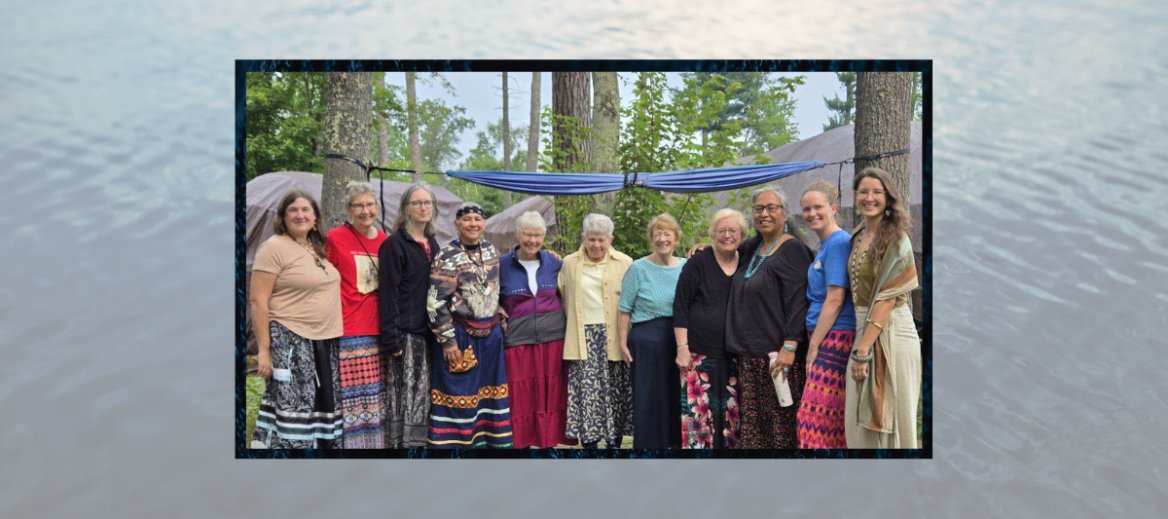
Photo above: Participants of the Women & Water Symposium included both women religious and members of Land Justice Futures, including Brenna Anglada, Mary Hroscikoski, OSF, Kristin Peters, FSPA, Joni Luna, SP, Colleen McGinnity, BVM, Ann DeNicolo, BVM, Marguerite Murphy, BVM, Kate Hendel, BVM, Patricia McCabe, Jessi Beck, SP and Sarah Bradley.