
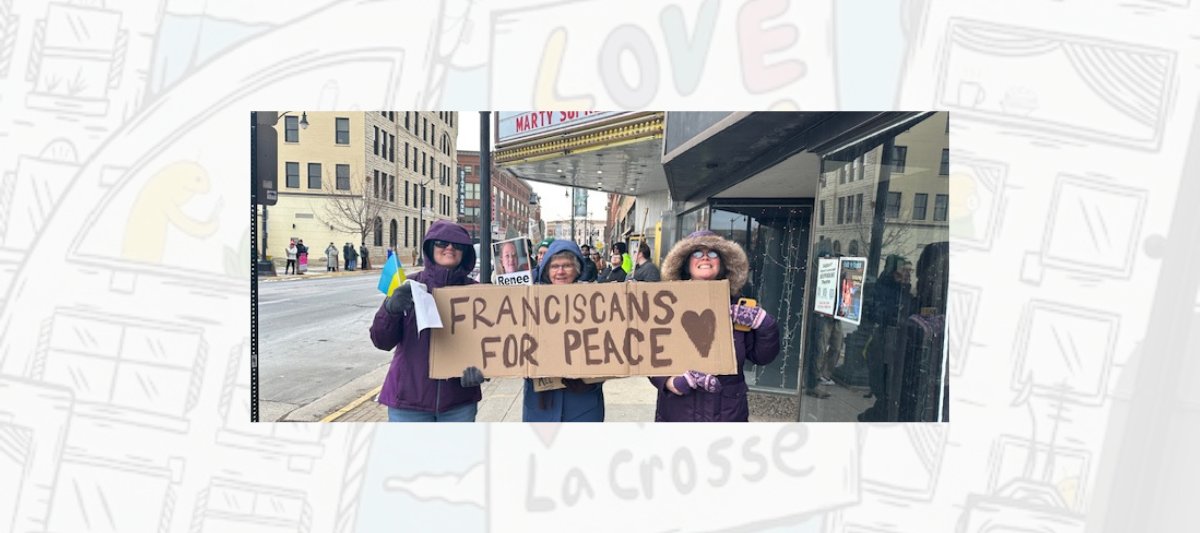
FSPA stands with the Leadership Conference of Women Religious, of which we are a member, in boldly stating "...violence is not the Gospel response."
At this moment in history, when fear is normalized, violence is amplified, and democratic life is under strain in the United States and across the world, the Leadership Conference of Women Religious (LCWR) raises a clear and unwavering moral voice: violence is not the Gospel response.
The way of Jesus calls us to a love that refuses harm, rejects domination, and insists on the dignity of every person. Love demands more than silence or neutrality. It requires truth-telling, moral courage, and a willingness to stand publicly with those whose lives and rights are threatened. Nonviolence is not passivity; it is disciplined, courageous action rooted in justice and hope.
Across the globe and within our own communities — from Ukraine to Minneapolis — we see the tragic consequences of aggression. Violence does not resolve conflict or restore peace; it deepens wounds and multiplies suffering. Nonviolence, by contrast, requires profound interior strength and sustained commitment. It must be cultivated personally and communally, and practiced intentionally within social, political, and global systems.
Women religious have long understood this truth through lived experience. Since arriving in what would become the United States in 1727, congregations of women religious have participated in the shaping of this nation through education, healthcare, advocacy, and service to those most at risk. Throughout the evolving life of this democracy, women religious have sought to embody gospel values in public life, especially in times of moral crisis.
In continuity with this witness, we unequivocally denounce the use of violence in any form. We call upon individuals and communities — and especially those entrusted with leadership in local, state, and federal government — to choose paths that uphold human rights, protect democratic processes, and honor the dignity of life at every stage.
In these times, the members of LCWR commit to a public, prophetic presence rooted in prayer and expressed through concrete action. We pledge to make visible the Gospel through advocacy for nonviolence, racial justice, humane immigration policies, and care for our common home. Our hope does not rest in force or fear, but in the transformative power of love lived boldly and together.
Action
Advocate: NETWORK Advocates for Justice, Inspired by Catholic Sisters
Jan. 27, 2026
Last week, the House passed a series of funding bills, including a bill to increase funding for the Department of Homeland Security (DHS), that would fuel additional terror in our communities. The Senate is scheduled to vote on this bill as early as Wednesday, January 28. We need your help to stop the government from using our taxpayer money to fund the lethal, inhumane actions of Immigration Customs Enforcement (ICE) and U.S. Customs and Border Protection (CBP)!
Let your senators know that they must not increase funding to masked federal agents who use lethal force to harm and kill us! And tell them to vote for programs and policies that help all of us thrive, such as community health centers, affordable medical care, and safe housing. We have prepared an action alert message that you can personalize. Click here to access the form to send your senators, finalize your message (from the template letter provided), and press send. It will be delivered to each of your senators.
Pray: Interfaith Alliance and Faith in Action
"We ask them for the love of God and the love of human beings, which can’t be separated: vote against renewing funding for such a lawless organization.”
Speaking during Sunday night’s national faith call organized by Faith in Action, Cardinal Tobin, Archbishop of Archdiocese of Newark and one of the highest-ranking Catholic leaders in the United States, called on his fellow Americans of faith to say no to violence and urged members of Congress to vote against funding for ICE. Watch the recording via Interfaith Alliance's Facebook page here.
Local Acts of Solidarity
- Identify vulnerable populations in your community experiencing fear or limited access to daily needs.
- Consider organizing collections of: School supplies, Non-perishable food, Clothing and bedding, Partner with trusted local agencies to ensure distribution reaches those most in need.
- Seek out community defense models in your areas and attend a training to understand how to document and respond to ICE (click here for a training presented by States at the Core & Protect Rogers Park)
- Wisconsin: connect with Voces de la Frontera